简体中文
简体中文 Español
 Français
 Deutsch
 Русский
 Português
 Italiano
 日本语
日本语 한국어
한국어 العربية
 Türkçe
 Tiếng Việt
 ไทย
ไทย Indonesia
 Melayu


Pitfall Guide for High-Moisture Dough (70%-75%) Dividing & Mixing: Turning Water into Profit
Increasing dough hydration enhances toast volume, crumb softness, and shelf life, ultimately boosting yield and profit. However, handling sticky high-moisture dough often creates production bottlenecks—including motor jams, damaged gluten networks, and weight variations.
1. Core Pitfalls & Root Causes
High-hydration dough poses three major mechanical challenges on automated production lines:
- Gluten Network Damage & Stickiness
- Root Cause: Standard dividers lack anti-stick surface treatments and precise tension control, causing shearing forces that tear fragile gluten structures.
- Severe Weight Inconsistency
- Root Cause: Trapped air bubbles and fluid dough dynamics in standard mechanical dividers lead to weight fluctuations exceeding ±5g per unit.
- Thermal Overheating During Mixing
- Root Cause: High-friction horizontal mixers generate excess kinetic heat, pushing core dough temperatures beyond target levels and causing premature yeast activation.
2. Equipment Selection & Technical Solutions
| Production Stage | Equipment Specification | Key Technical Feature | Operational Advantage |
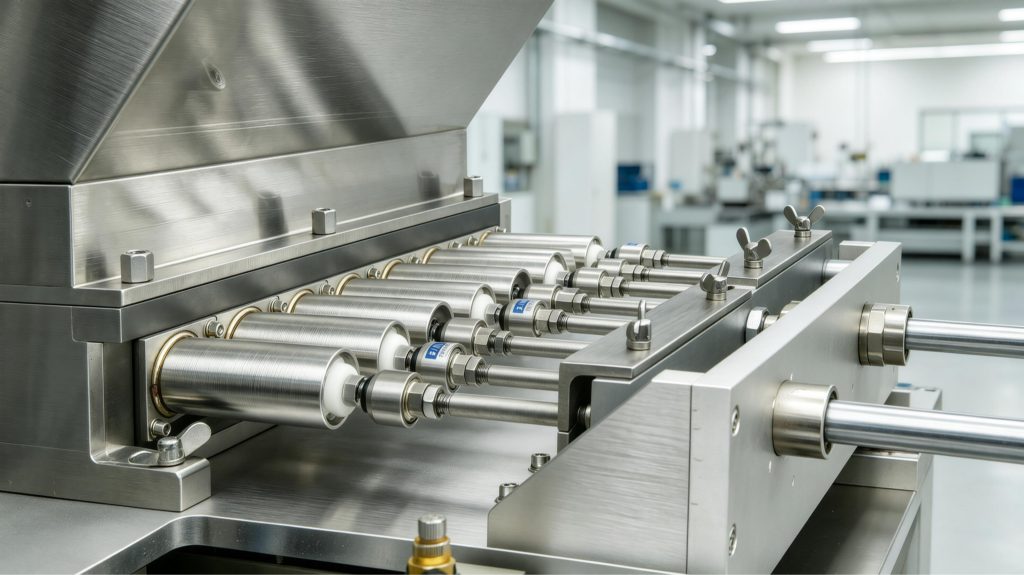
| Dividing & Portioning | Vacuum-Assisted Volumetric Divider | Dual-piston volumetric system with integrated vacuum control | Maintains portion accuracy within ±1g by removing air pockets |
| Surface Handling | Anti-Stick Discharge Setup | Food-grade Teflon coatings, motorized roller scrapers, automatic flour dusters | Prevents line jams and preserves dough surface integrity |
| Mixing & Kneading | Double-Roller Spiral / Arm Mixer | Triple 2-roller mixing rods emulating manual folding action | Kneads 70%–75% hydration dough gently without destroying gluten |
| Temperature Control | Jacket-Chilled Mixing Bowl | Double-walled cooling bowl connected to a fluid chiller | Controls friction heat to maintain core dough temperature at 24°C–26°C |
3. Operational Best Practices (Dividing & Mixing)
- Hydration Phase-In: Add 80% of the water during initial gluten development; gradually add the remaining 20% (“bassinage”) after the gluten matrix begins to form.
- Chilled Influx: Maintain mixing water temperatures between 2°C and 4°C to offset frictional heat generation.
- Calibrated Flour Dusting: Use automated, micro-adjustable flour dusting on discharge conveyors to prevent stickiness without drying out dough surfaces.
- Routine Cleaning Schedule: Clean Teflon contact surfaces and scrapers regularly to avoid dough buildup and uneven portioning.
4. Frequently Asked Questions (FAQ)
Q1: Why does high-hydration dough tear during automatic dividing?
A: Standard mechanical dividers rely on high pressure and cutting blades that shear delicate gluten networks. Switching to a gentle vacuum-assisted volumetric divider eliminates excessive compression, preserving dough extensibility.
Q2: How can dough temperature be kept below 26°C during intensive mixing?
A: Use ice-water mixtures, double-jacketed chilled bowls, and lower mixing speeds during early stages to minimize friction heating while maintaining optimal gluten formation.
Q3: Will anti-stick coatings alter the final product texture?
A: Food-grade Teflon coatings reduce surface tension without requiring excessive dusting flour, preserving crumb moisture and uniform appearance.
Modern bakery automation balances hydration efficiency with mechanical precision. Upgrading to temperature-controlled mixing and vacuum-assisted dividing ensures consistent quality, reduced scrap rates, and maximized profit margins.